Yoga at work : The Art of Living
One of the most wonderful aspects of yoga is that it can be practiced anywhere – whether in a studio, a gym, on the beach, on a mountain top, or even in our office or workplace.
Many people develop poor posture when sitting at a desk all day, resulting in neck and back pain. Further, with insufficient or no exercise, circulation slows down and very little blood flows through to the muscles. With oxygen flow inhibited, the muscles begin to contract to conserve oxygen. Tension builds in the neck, the shoulders and the back.
There are some simple and gentle yoga stretches and techniques that may be performed even when sitting at a desk or computer. Stretching oxygenates the blood, improves blood flow to the muscles and relieves tension. It also increases blood flow to the brain, which improves concentration and clarity of thought. It helps to alleviate the number one work – related problem, stress.
These stretches may be done periodically throughout the day, and may be complemented with a quick brisk walk around the office. Those who sit at a computer all day may use these techniques to relieve the resultant cramps and aches of the chest, shoulders, arms, hands and fingers.
Taking just a few minutes a day can make us more productive and benefit our overall physical and mental health.
Wrist and elbow Rotation
Sit with your back straight in your chair and rotate both wrists, slowly, ten times in the clockwise and ten times in the anti-clockwise direction. Rotate your arm at the elbow, ten times in each direction. This exercise may be repeated two or three times in a day.
Relaxing the Neck and Shoulders
Start by lowering your head forward towards your chest. Close your eyes and hold this position for a few moments, while concentrating on relaxing the muscles in the back of your neck. After a few moments, slowly roll your head from side to side. Be careful to go only to the sided and not roll your head to the back, as you want to relax your muscles, not overextend your neck.
Next, concentrate on your shoulders. Let your head relax in an upright but natural position. Begin by rolling your shoulders forward. Hold this position, allowing time for the muscles along the upper part of your back to relax. Then slowly roll your shoulders forward and back, up and down, increasing circulation to the neck and upper back area.
Relaxing your Chest
Clasp your hands in front of you, palms facing outwards. Round the back and stretch forward, allowing the upper and mid back to stretch. Again, hold for a few moments. You may close your eyes if you wish and breath slowly and deeply. Then, keeping your hands clasped, stretch your arms up over head and gently stretch back, opening the chest. Again, breathe deeply and just take a moment to relax.
Seated Katti Chakrasana
Keeping your back straight, lift both arms in front, palms still facing each other, slowly twist your body at the waist, first to the right, and then to the left.
Ankle rotation
Rotate your ankles, one at a time, ten times in the clockwise and ten times in anti clockwise direction.
Pushing the wall
Stand with your legs two to three feet apart, with the right foot facing out and the left leg turned inward slightly. Lift arms to shoulder level, lean towards the right at the waist, and with the base of your right palm, push an imaginary wall. Push as hard as you can, do not exert. Feel the stretch along your right arm, and hold this position for a few moments. Smile, relax and enjoy the stretch. Repeat on the other side, with the left foot facing out and the right leg turned inward slightly.
All Right Reserved (C) 2006-2007, The Art of Living Foundation
http://www.artofliving.org/
:::::::::::::::::::::::::::::::::::::::::::::::::::::::::::::::::::::::::::::::::::::::::::::::::::::
GokuRakuAn
Daruma Museum, Japan
:::::::::::::::::::::::::::::::::::::::::::::::::::::::::::::::::::::::::::::::::::::::::::::::::::::
1/03/2006

1/02/2006
Spring Meditation
March 21, First Day of Spring:
12 Ways to Inaugurate the Season
© By Frederic and Mary Ann Brussat
http://www.spiritualityandpractice.com/days/features.php?id=10961
"Just as there are seasons in the world around us, so there are in our interior life," Teresa of Avila wisely observed. "We cannot expect it to be otherwise."
Spring is a season of renewal and rebirth. It's a time when buds become leaves and flowers, when healing rain washes city streets and falls like grace on parched country fields, when the hard ground beneath us softens to allow shoots of new life to emerge.
As outside, so inside. Spring is a time for cleaning out and making way for fresh possibilities and new commitments. It's a time to revive our senses and expand our horizons. It's a time to begin again.
With all that in mind, we have designed some spiritual exercises for your celebrations of the start of spring this week. Hopefully, they will help hasten an interior rejuvenation to match all the marvels going on around us.
1. Start Your Days with Rejuvenating Imagery
In the morning before breakfast, do this imagery exercise for rejuvenation, overall health, healing, and energy. Called "Tree of Life," it was given to us by Fran Greenfield.
Close your eyes and breathe out slowly three times.
See yourself walking along a path where ahead of you is a strong, tall tree.
Go to this tree and embrace it, knowing this is the tree of life.
Now stand beside the tree, leaning up against it.
As you stand here, feel yourself becoming as one with the tree.
Feel your toes curling down into the earth, drawing in its nutrients and strength.
Feel your torso becoming as the trunk,
and your arms reaching up through the branches.
As you and the tree merge together completely, see and feel its sap rising and circulating throughout, imbuing you with strength, peace, and the power to heal. Know and feel how the tree's chlorophyll is giving you energy.
Feel how it is to be the roots, the trunk, the branches, and the leaves of the tree.
As the golden sun warms you and the fresh breeze stirs you, imagine yourself in full bloom.
Feel and know how it is to be ageless — strong and full of life.
See how you are connected above and below,
to heaven and earth, to all that is, was, and that ever will be . . .
Breathe out one time, and slowly return now,
feeling rejuvenated, awake, aware, and entirely yourself.
Thank the tree for this experience. Then slowly open your eyes.
2. Clear Your View
Wash the windows of your house or apartment. Then spend some time in meditation clearing away the dirt that clouds your vision. Let go of any hurts, grudges, and resentments you may be holding. If there is anyone you need to forgive, including yourself, do so. Then create a ritual to signify that you are cleaning and polishing the windows of your heart.
3. Find a Friend
Find a stone companion that you can carry in your pocket. Look for a small pebble in a park, in a creek or river bed, at the seashore, in your backyard, or at a store that specializes in minerals. Pick one that speaks to you. According to James Wanless, author of Little Stone, this "friend for life" can be a conveyer of wisdom, a protector, an example of self-creation, a metaphor for peace, and a model of simplicity.
4. Clean Your Assistants
Gather together all the tools that have served you well during the past year and give them a good spring cleaning, getting rid of rust and grime, oiling parts, blowing out any dust that has collected inside them. Wipe off television and computer screens and telephone handsets. As you work, tell the tools how grateful you are to them for their assistance.
5. Practice Unity
Try the following Zen practice. As you are drinking a cup of green tea, say, "In my hands I hold a bowl of tea. I see all of nature represented in its green color. Closing my eyes I find green mountains and pure water within my own heart. Silently drinking, I feel these become part of me."
6. Do a Walking Meditation
Thich Nhat Hanh, the Vietnamese monk, has written: "Touching the earth is a deep practice that can restore our peace and joy. One of the best ways to touch the earth is by practicing walking meditation." On this spring day, go outside and walk slowly, in a relaxed way, keeping a light smile on your lips. Be truly present with each step you take, being mindful of your walking. For more instructions and commentary on this practice, see Thich Nhat Hanh's little book The Long Road Turns to Joy: A Guide to Walking Meditation.
7. Spend Quality Time with Your House Plants
Give your houseplants the experience of spring renewal. Repot any that need it. Take them to the shower and give them a good misting. As you put them back in place, praise their beauty and resilience.
8. Do an Energy Fast
To participate more directly in Earth's rhythm of light and dark, use no electric lights for 24 hours. To get back in touch with the smells and textures of your food, use no appliances while cooking for a day. To experience the true sounds of your world, don't turn on the television, radio, or music system today.
9. Savor the Wonders
Read some haiku poems to focus your mind and senses on the wonders of spring; then try writing your own poems. Clark Strand's Seeds from a Birch Tree: Writing Haiku and the Spiritual Journey is an excellent primer.
Here's one example by Saryu to get your started:
"Without a brush
The willow paints the wind."
10. Get to Know Your Neighbors
Obtain field guides to the plants, trees, birds, and small animals indigenous to your area. Read up on their distinguishing marks, behavior patterns, territory, diet, and other qualities. Go for a walk and greet your neighbors by their names.
11. Cherish Beauty Afresh
Watch the video movie Enchanted April about four Englishwomen who rent a medieval castle in Italy for a month. This paradisiacal place tutors them in the spiritual arts of letting go, luxuriating in the senses, and loving. They discover that a vacation can be a soulmaking experience when it emphasizes the path of the heart, reverie, wonder, counting one痴 blessings, and living in the present moment. Ponder the ways in which the change of seasons enhances the feeling textures of your life.
12. End Your Days with Prayer
The Earth is always a good teacher — and especially in spring. End your days this season with this prayer from the Native American tradition.
Earth teach me stillness
as the grasses are stilled with light.
Earth teach me suffering
as old stones suffer with memory.
Earth teach me humility
as blossoms are humble with beginning.
Earth teach me caring
as the mother who secures her young.
Earth teach me courage
as the tree which stands all alone.
Earth teach me limitation
as the ant which crawls on the ground.
Earth teach me freedom
as the eagle which soars in the sky.
Earth teach me resignation
as the leaves which die in the fall.
Earth teach me regeneration
as the seed which rises in the spring.
Earth teach me to forget myself
as melted snow forgets its life.
Earth teach me to remember kindness
as dry fields weep with rain.
— Ute prayer
:::::::::::::::::::::::::::::::::::::::::::::::::::::::::::::::::::::::::::::::::::::::::::::::::::::
極楽庵
GokuRakuAn
だるま資料館
Daruma Museum, Japan
:::::::::::::::::::::::::::::::::::::::::::::::::::::::::::::::::::::::::::::::::::::::::::::::::::::
Soul Food
A Teaching Story
There was once a rabbi who was revered by the people as a man of God. Not a day went by when a crowd of people wasn't standing at his door seeking advice or healing or the holy man's blessing. And each time the rabbi spoke, the people would hang on his lips, drinking in his every word.
There was, however, in the audience a disagreeable fellow who never missed a chance to contradict the master. He would observe the rabbi's weaknesses and make fun of his defects to the dismay of the disciples, who began to look on him as the devil incarnate.
Well, one day the "devil" took ill and died. Everyone heaved a sigh of relief. Outwardly they looked appropriately solemn but in their hearts they were glad for no longer would the master's inspiring talks be interrupted or his behavior criticized by this disrespectful heretic.
So the people were surprised to see the master plunged in genuine grief at the funeral. When asked by a disciple later if he was mourning over the eternal fate of the dead man, he said, "No, no. Why should I mourn over our friend who is now in heaven? It was for myself I was grieving. That man was the only friend I had. Here I am surrounded by people who revere me. He was the only one who challenged me. I fear that with him gone, I shall stop growing." And as he said these words, the master burst into tears.
-- Anthony de Mello in The Heart of the Enlightened
© http://www.spiritualityandpractice.com/
:::::::::::::::::::::::::::::::::::::::::::::::::::::::::::::::::::::::::::::::::::::::::::::::::::::
極楽庵
GokuRakuAn
だるま資料館
Daruma Museum, Japan
:::::::::::::::::::::::::::::::::::::::::::::::::::::::::::::::::::::::::::::::::::::::::::::::::::::
Noguchi
The Way to a Whole Life
by Noguchi Haruchika
The great thing is to live in such a way that you feel the fascination of being awake rather than asleep.
Asleep or awake, continue to breathe comfortably in the way to a whole life.
Only for those who live life vigorously is there sound sleep.
Only for those whose life has been fulfilled is there a peaceful death.
Life and death are natural.
Since there is life, there is death;
since there is death, there is life.
Life and death are not separable.
Life and death naturally attend on each other.
This is the essence of a whole life.
Life is suffering
Death is ease.
For those who live in a vital way, there are many sufferings; if only ease exists, they fall asleep.
Only those who live in a vital way do not take sufferings as sufferings, but find within themselves the enjoyment that inheres in their situation.
Within people there are demands for self-preservation and a demand for the continuance of the species. These demands solidify, and a person is born, grows and lives.
Without knowing why we are born, why we live or why we die, we simply act in accordance with these inner demands.
Nature lives through human beings.
Living and dying exist within life.
Being in accord with nature -
this is the naturalness of life !
Katsugen Undo by Noguchi Sensei
:::::::::::::::::::::::::::::::::::::::::::::::::::::::::::::::::::::::::::::::::::::::::::::::::::::
極楽庵
GokuRakuAn
だるま資料館
Daruma Museum, Japan
:::::::::::::::::::::::::::::::::::::::::::::::::::::::::::::::::::::::::::::::::::::::::::::::::::::
by Noguchi Haruchika
The great thing is to live in such a way that you feel the fascination of being awake rather than asleep.
Asleep or awake, continue to breathe comfortably in the way to a whole life.
Only for those who live life vigorously is there sound sleep.
Only for those whose life has been fulfilled is there a peaceful death.
Life and death are natural.
Since there is life, there is death;
since there is death, there is life.
Life and death are not separable.
Life and death naturally attend on each other.
This is the essence of a whole life.
Life is suffering
Death is ease.
For those who live in a vital way, there are many sufferings; if only ease exists, they fall asleep.
Only those who live in a vital way do not take sufferings as sufferings, but find within themselves the enjoyment that inheres in their situation.
Within people there are demands for self-preservation and a demand for the continuance of the species. These demands solidify, and a person is born, grows and lives.
Without knowing why we are born, why we live or why we die, we simply act in accordance with these inner demands.
Nature lives through human beings.
Living and dying exist within life.
Being in accord with nature -
this is the naturalness of life !
Katsugen Undo by Noguchi Sensei

:::::::::::::::::::::::::::::::::::::::::::::::::::::::::::::::::::::::::::::::::::::::::::::::::::::
極楽庵
GokuRakuAn
だるま資料館
Daruma Museum, Japan
:::::::::::::::::::::::::::::::::::::::::::::::::::::::::::::::::::::::::::::::::::::::::::::::::::::
1/01/2006
Heart of Buddhism
Discovering the Heart of Buddhism
(C) Lama Shenpen Hookham 2006
http://www.buddhism-connect.org/
:::::::::::::::::::::::::::::::::::::::::::::::::::::::::::::::::::::::::::::::::::::::::::::::::::::
23 May 2006
How we can galvanise our practice when our motivation is low?
A student writes:
"Motivation can be a problem for someone like me, who hasn't had close links with teacher and Sangha. Although I feel I do often get adhistana from such things as considering the Truth of my experience, sometimes it all just feels like words to me - words that create no emotion and have no effect on my volition.
This is strange as recently I have consistently thought that all this is the most important thing I could ever do with my life - it just doesn't always touch my heart for some reason."
Lama Shenpen:
That is normal really, that is why it’s so difficult for us to reach enlightenment. Somehow we are just so asleep that even though we hear the alarm clock ringing we still don’t wake up. Even if someone shakes us we still find it hard to wake up - so we need all the help we can get.
Student:
"Anyway, what I wanted to ask was how do I practise with low motivation? If I just can't inspire myself to have my heart in the practice."
Lama Shenpen:
We all have to try to help each other - now you are part of a local group that is a good way to start helping others and being helped yourself. We all have to keep working on it, just keep on reflecting again and again on why we need to practise and gradually the penny drops and we start to feel really galvanised and eager to practise all the time.
Student:
"I realise ideally I would just always rest in the nature of my experience whatever it is."
Lama Shenpen:
It is good to make lots of pranidhanas to galvanise oneself and to think a lot about death and impermanence - that we don’t know how much time we have left to practice anyway. That helps a lot.
Death is good to reflect on because if you really think about it you realise you know nothing about death except that all that we are familiar with now won’t be there. And if you think about impermanence you realise it’s all gone already and what is to come will be gone as soon as it’s been.
So life and death are the same and there is absolutely nothing to hold on to - and that is the space that is us. That is our awareness - that great space - and if we are remembering that then we are remembering the Dharma. That is our practice - that is it!
http://www.buddhism-connect.org/default.asp?action=article&ID=1500
--- By Lama Shenpen Hookham
List of more teachings by Lama Shenpen
:::::::::::::::::::::::::::::::::::::::::::::::::::::::::::::::::::::::::::::::::::::::::::::::::::::
極楽庵
GokuRakuAn
だるま資料館
Daruma Museum, Japan
:::::::::::::::::::::::::::::::::::::::::::::::::::::::::::::::::::::::::::::::::::::::::::::::::::::
Tai Chi Chuan
:::::::::::::::::::::::::::::::::::::::::::::::::::::::::::::::::::::::::::::::::::::::::::::::::::::
© Original from the Japan Times Dec. 7, 2006
Taijiquan getting an all new workout
By RYOJU TOKAI
Kyodo News
The Chinese martial art Taijiquan, or Tai Chi, characterized by its slow movements and practiced as a method of exercise, is enjoying a second boom in Japan.
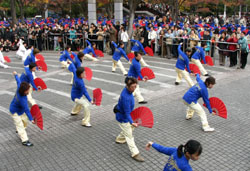
A special event called the Shibuya Taikyokuken (Taijiquan) Festival was held in Tokyo last month to mark the 50th anniversary of the creation of the "24-style simplified Taijiquan," which was derived from China's traditional martial arts for people interested in strengthening body and mind by practicing its slow routines and deep inhalation.
Taijiquan originated in China during the Ming and Qing dynasties in the 17th century based on the philosophy of positive and negative principles.
In 1956, martial arts expert Li Tianji devised the simplified form that subsequently became popular in China as a means of exercise.
The Tokyo festival included a Taijiquan practice by 1,000 people and a demonstration performance by Li Deyin, a professor at People's University of China and a chief referee at international Taijiquan contests.
He demonstrated gentle but powerful motions, his feet and the ground in perfect balance. Using fans and swords, teachers taught participants various forms of exercise, and some enthusiastically asked questions about how to improve their equilibrium and style.
"Taijiquan is physical exercise using the mind. Use your entire mind and move your body," Li said.
"There are not many sports that the elderly can play, but thanks to Taijiquan I am now strong in my legs and lower back," said Michiko Kodama, 69, who took up the art three years ago. "I don't trip up. I concentrate on it, but I am happy because I can relax."
The festival was sponsored by the Taijiquan Friendship Association in Japan, the Chinese government, the Beijing People's Association for Friendship with Foreign Countries and other entities. The society is one of the largest groups of its kind in Japan. Membership has nearly doubled in the last five years to about 1,800.
"The number of middle-aged and older women in particular is growing," Association President Yoshinori Koike said. "Taijiquan is rather difficult (to master). Many people are hooked by its depth. Since it is suited to an individual's physical strength, three generations -- a grandmother, mother and granddaughter -- can enjoy it together."
Taijiquan found its way to Japan in 1959 and a group of young people, including Koike who received training from Li Tianji, practiced it. Its first boom here occurred in the late 1970s after TV stations broadcast commercials showing some Beijing citizens doing exercises in slow and relaxed movements.
It is believed about 1 million Japanese currently practice Taijiquan. Classes and group activities are spreading across the country, and the municipal government in Kitakata, Fukushima Prefecture, has declared the city "Taijiquan town."
Taijiquan gatherings have been held every August since 2003 at the Roppongi Hills complex in Tokyo, gaining the attention of businesspeople and salaried men and women.
The sport tends to be regarded as an exercise for health but is actually a full-scale martial art -- a form of "wushu," which consists of "taolu" (forms) and "sanda" (sparring). Taolu is similar to gymnastics and involves martial arts maneuvers and defensive moves.
Professor Li said the essence of Taijiquan represents the unity of nature and human beings in Chinese philosophy, adding he hopes those who have obtained an understanding of the basic moves will explore the spiritual side. The supreme feeling attained from it, he said, is calmness and tranquillity.
The Japan Times (C) All rights reserved
:::::::::::::::::::::::::::::::::::::::::::::::::::::::::::::::::::::::::::::::::::::::::::::::::::::
INDEX OF ARTICLES FROM SYL WUSHU NEWSLETTER
http://www.shouyuliang.com/newsletter/index.shtml
極楽庵
GokuRakuAn
だるま資料館
Daruma Museum, Japan
:::::::::::::::::::::::::::::::::::::::::::::::::::::::::::::::::::::::::::::::::::::::::::::::::::::
© Original from the Japan Times Dec. 7, 2006
Taijiquan getting an all new workout
By RYOJU TOKAI
Kyodo News
The Chinese martial art Taijiquan, or Tai Chi, characterized by its slow movements and practiced as a method of exercise, is enjoying a second boom in Japan.

A special event called the Shibuya Taikyokuken (Taijiquan) Festival was held in Tokyo last month to mark the 50th anniversary of the creation of the "24-style simplified Taijiquan," which was derived from China's traditional martial arts for people interested in strengthening body and mind by practicing its slow routines and deep inhalation.
Taijiquan originated in China during the Ming and Qing dynasties in the 17th century based on the philosophy of positive and negative principles.
In 1956, martial arts expert Li Tianji devised the simplified form that subsequently became popular in China as a means of exercise.
The Tokyo festival included a Taijiquan practice by 1,000 people and a demonstration performance by Li Deyin, a professor at People's University of China and a chief referee at international Taijiquan contests.
He demonstrated gentle but powerful motions, his feet and the ground in perfect balance. Using fans and swords, teachers taught participants various forms of exercise, and some enthusiastically asked questions about how to improve their equilibrium and style.
"Taijiquan is physical exercise using the mind. Use your entire mind and move your body," Li said.
"There are not many sports that the elderly can play, but thanks to Taijiquan I am now strong in my legs and lower back," said Michiko Kodama, 69, who took up the art three years ago. "I don't trip up. I concentrate on it, but I am happy because I can relax."
The festival was sponsored by the Taijiquan Friendship Association in Japan, the Chinese government, the Beijing People's Association for Friendship with Foreign Countries and other entities. The society is one of the largest groups of its kind in Japan. Membership has nearly doubled in the last five years to about 1,800.
"The number of middle-aged and older women in particular is growing," Association President Yoshinori Koike said. "Taijiquan is rather difficult (to master). Many people are hooked by its depth. Since it is suited to an individual's physical strength, three generations -- a grandmother, mother and granddaughter -- can enjoy it together."
Taijiquan found its way to Japan in 1959 and a group of young people, including Koike who received training from Li Tianji, practiced it. Its first boom here occurred in the late 1970s after TV stations broadcast commercials showing some Beijing citizens doing exercises in slow and relaxed movements.
It is believed about 1 million Japanese currently practice Taijiquan. Classes and group activities are spreading across the country, and the municipal government in Kitakata, Fukushima Prefecture, has declared the city "Taijiquan town."
Taijiquan gatherings have been held every August since 2003 at the Roppongi Hills complex in Tokyo, gaining the attention of businesspeople and salaried men and women.
The sport tends to be regarded as an exercise for health but is actually a full-scale martial art -- a form of "wushu," which consists of "taolu" (forms) and "sanda" (sparring). Taolu is similar to gymnastics and involves martial arts maneuvers and defensive moves.
Professor Li said the essence of Taijiquan represents the unity of nature and human beings in Chinese philosophy, adding he hopes those who have obtained an understanding of the basic moves will explore the spiritual side. The supreme feeling attained from it, he said, is calmness and tranquillity.
The Japan Times (C) All rights reserved
:::::::::::::::::::::::::::::::::::::::::::::::::::::::::::::::::::::::::::::::::::::::::::::::::::::
INDEX OF ARTICLES FROM SYL WUSHU NEWSLETTER
http://www.shouyuliang.com/newsletter/index.shtml
極楽庵
GokuRakuAn
だるま資料館
Daruma Museum, Japan
:::::::::::::::::::::::::::::::::::::::::::::::::::::::::::::::::::::::::::::::::::::::::::::::::::::
LOHAS
Gentle Ecological Products Enrapture Japan
Read the Original here:
© YURI KAGEYAMA 2006 The Associated Press
http://www.chron.com/disp/story.mpl/ap/fn/3922185.html
TOKYO — June 2, 2006
A U.S. lifestyle concept that combines consumerism with a bit of ecological conscience is proving a hit in shopping-crazy Japan, where workaholic "salarymen" are looking for quick fixes for stress and thinking green is becoming fashionable.
LOHAS, which stands for Lifestyles of Health and Sustainability, an approach to purchasing and investment that originated in the United States about a decade ago, encompasses a wide range of products pushing social and environmental responsibility _ organic soap, recycled paper, hybrid cars, solar heating and herbal tea.
The trend is just beginning to catch on here, but it's estimated to represent a $540 billion global market.
Internet shopping sites are peddling LOHAS goods. A Tokyo department store has a section for LOHAS goods. Magazines are singing the praises of the LOHAS lifestyle, including yoga, organic wine, aroma therapy and the option of bringing your own grocery bag.
"We have to learn to make do with what we have," said Junko Shinohara, a 53-year-old housewife, after examining ecologically made towels at an exhibition of LOHAS goods opening Friday in downtown Tokyo.
The concept is appealing, partly because it isn't too demanding.
It doesn't require a stoic, idealistic way of life _ just some adjustment here and there. Instead of saying: "Don't ever drive a car," it merely says: "Buy a fuel-efficient car."
The idea is going mainstream in a much bigger way in Japan than in the U.S., with automakers, food manufacturers, homebuilders, even banks, showing interest in LOHAS marketing, says Peter D. Pedersen, president of Japanese consulting company E-square Inc.
"Even if you live a hectic lifestyle of a salaryman, there are things you can do," he said. "Why don't you do the things you can do and start from there? That's the idea."
Japan may be receptive to LOHAS because the nation's traditional culture embraces a nature-loving view on life with hot springs and seasonal gourmet, according to Pedersen.
The timing was also right. Japanese, who had felt lost after the speculative "bubble" burst in the 1990s, were looking for an alternative that went beyond the power of money, he said.
The idea of LOHAS is linked with "cultural creatives" proposed by American sociologist Paul Ray, who said people are starting to value health, social issues and other aspects of life that aren't directly linked with past patterns of materialistic consumption.
The idea originated as an open trademark, requiring no payment for usage, and so almost anything can claim to be LOHAS.
A restaurant serving everyday but healthy dishes such as brown rice and vegetable curry can claim to be LOHAS. Not littering is LOHAS. Composting household garbage is even more so. The values touch something as cheap as a hammock to something more expensive as Louis Vuitton luggage.
The recent Tokyo exhibition included an ergonomic chair, non-allergenic detergent, water bottles and Crocs Inc. sandals. A glass fishbowl by Italian designer Andrea Branzi had a glass birdcage inside so that goldfish swim around parakeets, making for what organizers said was a statement on coexistence.
Also on display were designs for "furoshiki," Japan's traditional answer to the reusable bag, a piece of fabric for carrying things by simply wrapping them. One with bright pictures of flowers and birds was designed by Environment Minister Yuriko Koike.
What's appealing about LOHAS is that it proposes everyday changes in personal life, proponents say.
"There's been a lot of talk about slow food and slow life," said Mari Takamatsu, spokeswoman for Mitsukoshi department store, which has a corner devoted to LOHAS cooking this week. "LOHAS puts a lifestyle into one word that consumers understand."
By YURI KAGEYAMA AP Business Writer
© 2006 The Associated Press
極楽庵のスローライフ/ローハス
Slow Life, LOHAS at GokuRakuAn
:::::::::::::::::::::::::::::::::::::::::::::::::::::::::::::::::::::::::::::::::::::::::::::::::::::
極楽庵
GokuRakuAn
だるま資料館
Daruma Museum, Japan
:::::::::::::::::::::::::::::::::::::::::::::::::::::::::::::::::::::::::::::::::::::::::::::::::::::
Read the Original here:
© YURI KAGEYAMA 2006 The Associated Press
http://www.chron.com/disp/story.mpl/ap/fn/3922185.html
TOKYO — June 2, 2006
A U.S. lifestyle concept that combines consumerism with a bit of ecological conscience is proving a hit in shopping-crazy Japan, where workaholic "salarymen" are looking for quick fixes for stress and thinking green is becoming fashionable.
LOHAS, which stands for Lifestyles of Health and Sustainability, an approach to purchasing and investment that originated in the United States about a decade ago, encompasses a wide range of products pushing social and environmental responsibility _ organic soap, recycled paper, hybrid cars, solar heating and herbal tea.
The trend is just beginning to catch on here, but it's estimated to represent a $540 billion global market.
Internet shopping sites are peddling LOHAS goods. A Tokyo department store has a section for LOHAS goods. Magazines are singing the praises of the LOHAS lifestyle, including yoga, organic wine, aroma therapy and the option of bringing your own grocery bag.
"We have to learn to make do with what we have," said Junko Shinohara, a 53-year-old housewife, after examining ecologically made towels at an exhibition of LOHAS goods opening Friday in downtown Tokyo.
The concept is appealing, partly because it isn't too demanding.
It doesn't require a stoic, idealistic way of life _ just some adjustment here and there. Instead of saying: "Don't ever drive a car," it merely says: "Buy a fuel-efficient car."
The idea is going mainstream in a much bigger way in Japan than in the U.S., with automakers, food manufacturers, homebuilders, even banks, showing interest in LOHAS marketing, says Peter D. Pedersen, president of Japanese consulting company E-square Inc.
"Even if you live a hectic lifestyle of a salaryman, there are things you can do," he said. "Why don't you do the things you can do and start from there? That's the idea."
Japan may be receptive to LOHAS because the nation's traditional culture embraces a nature-loving view on life with hot springs and seasonal gourmet, according to Pedersen.
The timing was also right. Japanese, who had felt lost after the speculative "bubble" burst in the 1990s, were looking for an alternative that went beyond the power of money, he said.
The idea of LOHAS is linked with "cultural creatives" proposed by American sociologist Paul Ray, who said people are starting to value health, social issues and other aspects of life that aren't directly linked with past patterns of materialistic consumption.
The idea originated as an open trademark, requiring no payment for usage, and so almost anything can claim to be LOHAS.
A restaurant serving everyday but healthy dishes such as brown rice and vegetable curry can claim to be LOHAS. Not littering is LOHAS. Composting household garbage is even more so. The values touch something as cheap as a hammock to something more expensive as Louis Vuitton luggage.
The recent Tokyo exhibition included an ergonomic chair, non-allergenic detergent, water bottles and Crocs Inc. sandals. A glass fishbowl by Italian designer Andrea Branzi had a glass birdcage inside so that goldfish swim around parakeets, making for what organizers said was a statement on coexistence.
Also on display were designs for "furoshiki," Japan's traditional answer to the reusable bag, a piece of fabric for carrying things by simply wrapping them. One with bright pictures of flowers and birds was designed by Environment Minister Yuriko Koike.
What's appealing about LOHAS is that it proposes everyday changes in personal life, proponents say.
"There's been a lot of talk about slow food and slow life," said Mari Takamatsu, spokeswoman for Mitsukoshi department store, which has a corner devoted to LOHAS cooking this week. "LOHAS puts a lifestyle into one word that consumers understand."
By YURI KAGEYAMA AP Business Writer
© 2006 The Associated Press
極楽庵のスローライフ/ローハス
Slow Life, LOHAS at GokuRakuAn
:::::::::::::::::::::::::::::::::::::::::::::::::::::::::::::::::::::::::::::::::::::::::::::::::::::
極楽庵
GokuRakuAn
だるま資料館
Daruma Museum, Japan
:::::::::::::::::::::::::::::::::::::::::::::::::::::::::::::::::::::::::::::::::::::::::::::::::::::
12/01/2005
Bird Flu
鳥インフレンザ Bird Flu
QUOTE:
http://www.med-owl.com/herbal-antivirals/tiki-index.php?page=Star+Anise
There has been increasing interest in Star Anise recently, as this herb is a raw material for manufacturing the antiviral medicine Tamiflu; Shikimic acid is extracted from anise, which undergoes a 17 step chemical process to transform it into Tamiflu (generic name: Oseltamivir).
In traditional Chinese Medicine, star anise is used for clearing mucus congestion from the respiratory tract, as a digestive aid to relieves gas and bloating, improve appetite, and assist with digestion. The oil has antispasmodic properties, and is used to stabilize and improve mood. (ITM online page on anise (cache)) It is not widely used for influenza in Chinese Medicine, but is used for flu in traditional Tibetan medicine. (article in China Daily (cache))
In 2003, the US Food and Drug Administration (FDA) issued a warning on the use of anise teas after approximately 40 reports of adverse effects. According to the advisory, Chinese Star Anise was believed to be contaminated with Japanese Star Anise. The Japanese variety is visually identical, but can cause neurotoxicity. FDA Advisory on Star Anise (cache).
Although star anise could have some direct antiviral effects, these have not been proven. One cannot assume that because Tamiflu is made from star anise, that star anise has the same properties as Tamiflu - it does not. At this time, I would put star anise on the 'interesting' list, but don't have evidence that it would be effective in treating H5N1 avian flu or any other serious disease.
The Latin name for star anise is Illicium verum HOOK. f. (sometime referred to by the older name Anisum setellatum.) The spice is popular in the cuisine of China, Vietnam, and other Asian countries, and it is a dominant flavor in the famous Five Spice powder. For a good overview of the culinary aspects of star anise, follow this link to Gernot Katzer's Spice Pages (cache).
H5N1 Avian Flu Disclaimer Copyright
:::::::::::::::::::::::::::::::::::::::::::::::::::::::::::::::::::::::::::::::::::::::::::::::::::::
Apitherapy and the Bird Flu
Put an extract of this Anise in propolis extract for better protection.
Propolis and honey as inhalation for the upper respiratory tract.
Take much more fluids than usual with your meals and inbetween.
:::::::::::::::::::::::::::::::::::::::::::::::::::::::::::::::::::::::::::::::::::::::::::::::::::::
極楽庵
GokuRakuAn
だるま資料館
Daruma Museum, Japan
:::::::::::::::::::::::::::::::::::::::::::::::::::::::::::::::::::::::::::::::::::::::::::::::::::::
Subscribe to:
Posts (Atom)